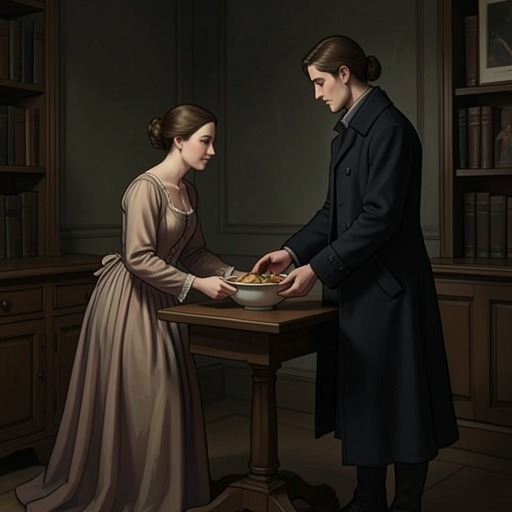
Marie-Josèphe and the sea monster
The Moon and the SunMarie-Josèphe and the sea monster form a relationship through gestures of care that precede any shared language. Their early encounters are uneasy: Marie-Josèphe tries to reassure the frightened creature, while it responds with startling physical force. By returning to the pool, offering food from her hand, and welcoming even its first attempt at speech, she makes trust something practiced between them rather than assumed.
First Contact and Fear
When a handler prods the sea monster with a goad to make it surface, Marie-Josèphe intervenes, kneeling on the platform and putting her hands into the water. She tells the creature it is safe, and it clutches her wrists with its webbed fingers. Its claws touch her skin like knife tips but do not cut; then it drags her into the pool. The moment joins reassurance and danger: the creature does not injure her, but its response is powerful and not under her control.
After the creature has previously tried to escape, Marie-Josèphe finds it near the fountain’s dawn chariot and notices that the planks are dry. She takes its stillness as fear, not docility, and returns to coax it rather than force it to move. Her response makes room for the possibility that its behavior comes from terror, even though she is also thinking in terms of training.
Repeated Care and Feeding
Marie-Josèphe uses familiar, gentle gestures to invite the sea monster closer. At the pool she pats the water as she would pat her bedcovers to call Hercules, then asks the creature to come to her. The gesture adapts an ordinary call to a setting in which they do not yet share speech, turning the water itself into an invitation.
Food becomes another occasion for cautious approach. When the sea monster swims a few arm-lengths from the stairs, Marie-Josèphe pleads with it to eat and holds out a live fish. It darts close enough for its claws to brush her fingers, snatches the fish, and pushes it into its mouth. Her delight is immediate: she praises it and catches another fish. The exchange depends on proximity that could be frightening, but she treats the creature’s careful reach as progress and continues offering food by hand.
The First Word
Marie-Josèphe’s hand-feeding continues even when a conversation with Yves has unsettled her. She nets the last fish and offers it barehanded; the sea monster swims within an arm’s length, and the fish thrashes between her fingers. As she calls the creature and names the food, it repeats the word fish. Marie-Josèphe catches her breath in delight and compares the sound to a parrot’s speech.
The moment does not establish that the two can converse, but it changes the character of their contact. Until then, Marie-Josèphe’s invitations and praise have met with movement and touch; now the sea monster answers with a recognizable word. Their relationship is built from the same small acts that make that answer possible: her return to the pool, her attention to fear, and her willingness to offer food from an unprotected hand.